
The BDSM Emblem is a widely recognised symbol within the BDSM community, yet it is often misunderstood or misidentified. This introduction aims to explain what the Emblem is, where its design comes from, and why its details matter, especially for those encountering it for the first time.
At the heart of the BDSM Emblem is a shape known as the Triskele (or Triskelion). The Triskele is an ancient symbol composed of three curved arms radiating from a central point. It has appeared in many cultures throughout history and has been associated with a wide range of meanings, from motion and balance to cycles and transformation.
Because of its long and varied history, it is important to understand that the Triskele itself is not a BDSM symbol. Many Triskeles exist in art, jewellery, and cultural iconography that have no connection to BDSM at all. The BDSM Emblem is a very specific interpretation of the Triskele, distinguished by intentional design elements and symbolic choices.
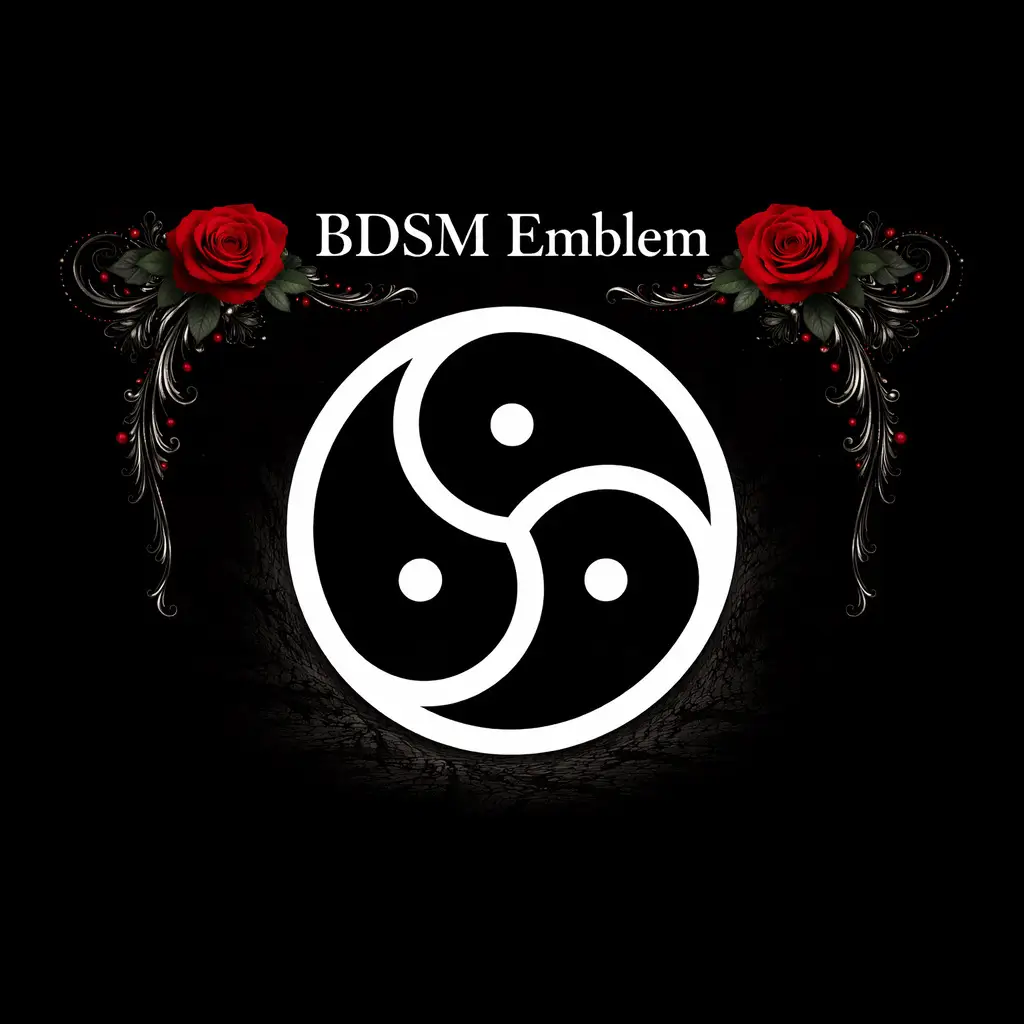
The BDSM Emblem was deliberately designed with precise features that set it apart from other Triskele-based designs. These include:
A black inner background
Metallic silver or gold-coloured rims and spokes
Three circular holes, often mistakenly described online as dots, which match the metallic colour of the lines
An enclosing outer circle that unifies the design
These elements are not decorative accidents. They were chosen carefully to create a symbol that could communicate meaning to those familiar with it, while remaining visually subtle to others.
One of the core purposes of the BDSM Emblem is discreet recognition. When it was introduced, the intention was to provide a way for individuals within the BDSM community to identify one another without drawing unwanted attention or publicly disclosing personal interests.
To support this goal, the Emblem was designed to appear neutral and aesthetically pleasing rather than provocative or explicit. To someone outside the lifestyle, it typically looks like an abstract or spiritual design, sometimes even resembling the yin-yang symbol. This intentional ambiguity allows it to blend naturally into everyday settings, such as jewellery, clothing, or artwork.
Over time, however, the Emblem spread widely across the internet and social media, often without its original explanation. As a result, some people began to assume that any Triskele symbol represented BDSM. This is a common misconception. The BDSM Emblem is defined by its specific design and symbolic intent, not by the Triskele shape alone.
For those who understand its meaning, the BDSM Emblem carries multiple layers of symbolism, each connected to fundamental aspects of BDSM philosophy and structure.
The most direct symbolism lies in the three curved sections of the Emblem, which represent the three commonly recognised components of BDSM:
Bondage and Discipline (B&D)
Domination and submission (D&S)
Sadism and Masochism (S&M)
These elements describe different but interconnected ways power, control, sensation, and trust can be expressed within consensual BDSM dynamics.
The three divisions also reflect the ethical framework that underpins responsible BDSM practice: Safe, Sane, and Consensual. This principle emphasises informed consent, mutual understanding, and care for the physical and emotional wellbeing of all participants. It serves as a guiding standard within the community and reinforces that BDSM is built on communication and responsibility, not harm.
Another layer of symbolism refers to the roles commonly recognised within BDSM interactions:
Tops, who take an active or directive role
Bottoms, who receive or submit within agreed dynamics
Switches, who may engage in both roles depending on context
These roles are not rigid identities but general frameworks that help describe how individuals interact within consensual power exchanges.
The three holes within the Emblem are a distinctive and meaningful feature. They symbolise the idea that, within BDSM, individuals are not entirely complete in isolation. BDSM is inherently relational—it relies on interaction, consent, and mutual participation.
The holes represent openness, receptivity, and the understanding that connection with a complementary partner is essential. Whether BDSM is approached as a form of play, exploration, or deep emotional bonding, it cannot exist alone. The design visually reinforces the idea that relationships and dynamics are central to the lifestyle.
The curved lines of the Emblem echo the flowing boundaries between the different aspects of BDSM. Just as the curved line in the yin-yang symbol suggests that opposites are interconnected rather than sharply divided, the curves here reflect the fluidity between B&D, D&S, and S&M.
The metallic colour of the rims and spokes evokes traditional imagery associated with BDSM, such as chains, collars, or restraints. Rather than symbolising oppression, these elements represent commitment, structure, and negotiated power exchange.
The black inner sections are often interpreted as a nod to the private nature of BDSM. Black is frequently associated with secrecy or the unknown, and in this context it reflects discretion rather than negativity. It acknowledges that BDSM is often kept separate from public life and shared only with those who are trusted.
The outer circle of the Emblem brings all elements together. It symbolises unity, wholeness, and continuity. Within the BDSM context, it can be understood as representing the community itself—a network of individuals connected by shared values of consent, trust, respect, and understanding.
Ultimately, the BDSM Emblem is not meant to explain itself openly. Its purpose is not to educate the uninformed at a glance, but to offer recognition to those who already understand its meaning. To outsiders, it remains simply an attractive design. To those within the lifestyle, it serves as a subtle sign of belonging and shared knowledge.
Unfortunately, the level of secrecy and discretion for which the Emblem was originally designed is no longer as strong as it once was. As the lifestyle has become more visible and less underground, the symbol has increasingly been adopted by people who simply wish to express that they are “kinky,” even if they are not involved in BDSM as a lifestyle. In a separate article, I will explore the important distinction that not all kinksters are part of BDSM, while all BDSM practitioners are, by definition, kinksters. As the lifestyle has become more widespread, additional symbols have emerged to represent various aspects of it. In my view, however, these are largely unnecessary. The BDSM Emblem on its own is sufficient, and there is no real need for a different symbol to represent every individual element of the lifestyle.