
Power exchange in BDSM is built through clarity, repetition, and how roles are lived day to day.

Power Exchange in BDSM: Mastery & Balance in D/s and M/s Relationships

Power exchange in BDSM sits at the heart of D/s and M/s relationships, yet it remains one of the most misunderstood aspects of the BDSM lifestyle. Too often, it is reduced to surface-level control or mistaken for hierarchy without substance. When viewed this way, power exchange appears rigid, performative, or even hollow. In reality, it is neither casual nor theatrical. It is a conscious, negotiated structure built on responsibility, trust, and emotional discipline. When practised with integrity, power exchange becomes less about authority taken and far more about authority carried. At its core, power exchange is not about enforcing obedience but about creating a space where surrender can exist safely. This distinction is critical. Control that is demanded produces resistance or compliance without depth. Authority that is earned invites devotion, presence, and trust. In BDSM, power exchange only functions when both sides understand that authority is not self-generated. It exists because it has been granted, and it must be honoured continuously through conduct rather than words. Mastery, within this context, is not something one claims. It cannot be announced, demanded, or assumed through titles alone. Mastery reveals itself gradually through consistency, clarity, and restraint. A Master is not defined by how loudly he commands, but by how steadily he holds responsibility when no one is watching. His authority exists only because another has chosen to offer trust — and that trust is not static. It must be reaffirmed daily, especially when it becomes inconvenient or demanding. Ownership is perhaps even more frequently misunderstood within power exchange in BDSM. In D/s and M/s dynamics, ownership is symbolic, intentional, and consensual. It is never about possession in a crude or literal sense. When a submissive offers herself into ownership, she is not surrendering her worth or autonomy. She is offering devotion within clearly defined boundaries. That offering does not diminish her; it deepens the dynamic and elevates accountability on both sides. Ethical ownership increases responsibility rather than removing it. Responsibility is the quiet backbone of all power exchange in BDSM. Without it, authority collapses into control and submission becomes unsafe. If a Master restrains, he must understand the body he restrains. If he expects surrender, he must provide safety — emotional as well as physical. Responsibility does not weaken authority; it legitimises it. The more that is entrusted, the more carefully it must be protected. Power that cannot safeguard what it removes has no ethical foundation. Balance is what keeps power exchange alive and meaningful over time. Without balance, mastery becomes rigid and ownership devolves into entitlement. A healthy D/s or M/s relationship exists in constant calibration between strength and care, authority and empathy, structure and awareness. Balance is not passive. It requires reflection, adjustment, and the willingness to listen. A Master who listens is not weakened; he is disciplined. Leadership that cannot adapt eventually fractures under its own weight. It is also essential to recognise that the BDSM lifestyle does not erase humanity. Masters are not machines, and submissives are not objects. Both remain whole individuals who think, feel, doubt, and grow. The distinction lies not in worth but in how power is consciously exchanged and responsibly held. When a dynamic ignores the humanity of either side, it ceases to be power exchange and becomes something else entirely. In deeper M/s relationships, where structure may extend beyond scenes and into daily life, balance becomes an ongoing discipline rather than a fixed achievement. Ownership does not excuse neglect. Authority does not cancel accountability. A Master remains responsible not only for obedience, but for the emotional stability, dignity, and wellbeing of the submissive who has placed trust in him. The depth of the dynamic increases the weight of responsibility rather than reducing it. True power exchange in BDSM is rarely loud. It does not rely on constant assertion, spectacle, or performance. It is steady, grounded, and often quiet. It reveals itself in how limits are respected, how decisions are made, and how trust is preserved under pressure. When mastery, ownership, and balance align, D/s and M/s relationships move beyond fantasy and into lived reality — rooted in trust, devotion, and mutual purpose. Ultimately, mastery is not about taking; it is about holding. Ownership is not about claiming; it is about safeguarding. Balance is what ensures that power exchange in BDSM remains ethical, sustainable, and deeply human. When these elements exist together, domination ceases to be a display of control and becomes an expression of responsibility carried with care.
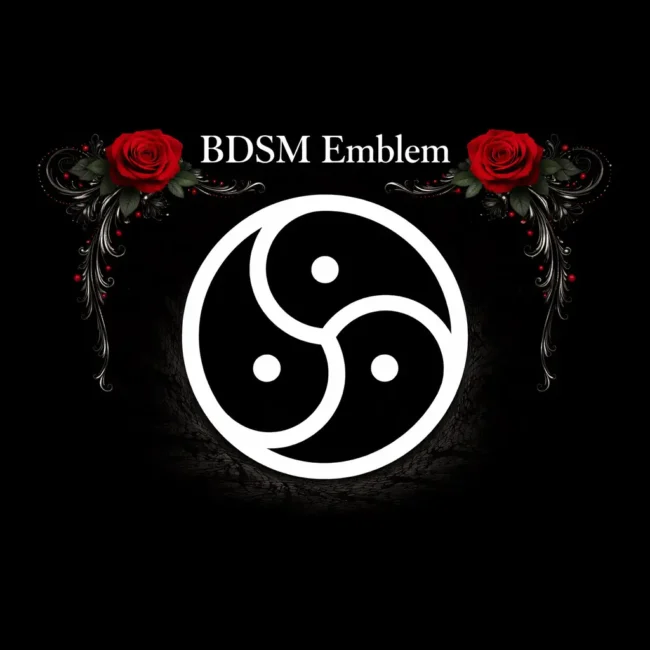

A BDSM emblem featuring a triskelion symbol framed by red roses, representing balance, power exchange, and responsibility within the BDSM lifestyle.

Understanding the BDSM Emblem – Meaning, Design, and Purpose

The BDSM Emblem is a widely recognised symbol within the BDSM community, yet it is often misunderstood or misidentified. This introduction aims to explain what the Emblem is, where its design comes from, and why its details matter, especially for those encountering it for the first time. The Triskele as the Foundation At the heart of the BDSM Emblem is a shape known as the Triskele (or Triskelion). The Triskele is an ancient symbol composed of three curved arms radiating from a central point. It has appeared in many cultures throughout history and has been associated with a wide range of meanings, from motion and balance to cycles and transformation. Because of its long and varied history, it is important to understand that the Triskele itself is not a BDSM symbol. Many Triskeles exist in art, jewellery, and cultural iconography that have no connection to BDSM at all. The BDSM Emblem is a very specific interpretation of the Triskele, distinguished by intentional design elements and symbolic choices. What Makes the BDSM Emblem Unique The BDSM Emblem was deliberately designed with precise features that set it apart from other Triskele-based designs. These include: A black inner background Metallic silver or gold-coloured rims and spokes Three circular holes, often mistakenly described online as dots, which match the metallic colour of the lines An enclosing outer circle that unifies the design These elements are not decorative accidents. They were chosen carefully to create a symbol that could communicate meaning to those familiar with it, while remaining visually subtle to others. A Symbol Designed for Discretion One of the core purposes of the BDSM Emblem is discreet recognition. When it was introduced, the intention was to provide a way for individuals within the BDSM community to identify one another without drawing unwanted attention or publicly disclosing personal interests. To support this goal, the Emblem was designed to appear neutral and aesthetically pleasing rather than provocative or explicit. To someone outside the lifestyle, it typically looks like an abstract or spiritual design, sometimes even resembling the yin-yang symbol. This intentional ambiguity allows it to blend naturally into everyday settings, such as jewellery, clothing, or artwork. Over time, however, the Emblem spread widely across the internet and social media, often without its original explanation. As a result, some people began to assume that any Triskele symbol represented BDSM. This is a common misconception. The BDSM Emblem is defined by its specific design and symbolic intent, not by the Triskele shape alone. Symbolism Within the Design For those who understand its meaning, the BDSM Emblem carries multiple layers of symbolism, each connected to fundamental aspects of BDSM philosophy and structure. The Three Divisions of BDSM Practice The most direct symbolism lies in the three curved sections of the Emblem, which represent the three commonly recognised components of BDSM: Bondage and Discipline (B&D) Domination and submission (D&S) Sadism and Masochism (S&M) These elements describe different but interconnected ways power, control, sensation, and trust can be expressed within consensual BDSM dynamics. The Ethical Foundation: Safe, Sane, and Consensual The three divisions also reflect the ethical framework that underpins responsible BDSM practice: Safe, Sane, and Consensual. This principle emphasises informed consent, mutual understanding, and care for the physical and emotional wellbeing of all participants. It serves as a guiding standard within the community and reinforces that BDSM is built on communication and responsibility, not harm. Community Roles Another layer of symbolism refers to the roles commonly recognised within BDSM interactions: Tops, who take an active or directive role Bottoms, who receive or submit within agreed dynamics Switches, who may engage in both roles depending on context These roles are not rigid identities but general frameworks that help describe how individuals interact within consensual power exchanges. The Meaning of the Holes The three holes within the Emblem are a distinctive and meaningful feature. They symbolise the idea that, within BDSM, individuals are not entirely complete in isolation. BDSM is inherently relational—it relies on interaction, consent, and mutual participation. The holes represent openness, receptivity, and the understanding that connection with a complementary partner is essential. Whether BDSM is approached as a form of play, exploration, or deep emotional bonding, it cannot exist alone. The design visually reinforces the idea that relationships and dynamics are central to the lifestyle. Curves, Metal, and Colour The curved lines of the Emblem echo the flowing boundaries between the different aspects of BDSM. Just as the curved line in the yin-yang symbol suggests that opposites are interconnected rather than sharply divided, the curves here reflect the fluidity between B&D, D&S, and S&M. The metallic colour of the rims and spokes evokes traditional imagery associated with BDSM, such as chains, collars, or restraints. Rather than symbolising oppression, these elements represent commitment, structure, and negotiated power exchange. The black inner sections are often interpreted as a nod to the private nature of BDSM. Black is frequently associated with secrecy or the unknown, and in this context it reflects discretion rather than negativity. It acknowledges that BDSM is often kept separate from public life and shared only with those who are trusted. The Enclosing Circle The outer circle of the Emblem brings all elements together. It symbolises unity, wholeness, and continuity. Within the BDSM context, it can be understood as representing the community itself—a network of individuals connected by shared values of consent, trust, respect, and understanding. A Quiet Symbol of Recognition Ultimately, the BDSM Emblem is not meant to explain itself openly. Its purpose is not to educate the uninformed at a glance, but to offer recognition to those who already understand its meaning. To outsiders, it remains simply an attractive design. To those within the lifestyle, it serves as a subtle sign of belonging and shared knowledge. Unfortunately, the level of secrecy and discretion for which the Emblem was originally designed is no longer as strong as it once was. As the lifestyle has become more visible and less underground, the symbol has increasingly been adopted by…

A kneeling woman in lingerie with a calm, introspective posture, guided by a standing man, symbolising the BDSM lifestyle, power exchange, and the inner world of desire shaped through erotic triggers.

Inner World of Kink Shaped by Desire, Triggers, and Human Sexuality

The world of kink is often misunderstood because it is rarely looked at through the lens of desire itself. Instead, it is judged through morality, habit, or fear. When that happens, kink is reduced to extremes or dismissed as something abnormal. In lived reality, it is far simpler and far more human. Kink begins where desire refuses to fall asleep. Some people can repeat the same intimate patterns for decades without feeling dulled by them. Others cannot. Their desire fades when intimacy becomes predictable. It is not that they love less, or seek novelty for its own sake. Their mind requires stronger, more specific triggers to remain alive to arousal, tension, and connection. This difference is not about intelligence, morality, or emotional maturity. It is about how stimulation is processed. Human sexuality does not function like an on-off switch. It responds to cues. Images. Symbols. Power dynamics. Restriction. Freedom. Anticipation. For some, a familiar touch is enough. For others, familiarity softens desire until it becomes background noise. When that happens, the body does not stop wanting. It starts searching. This is where the inner world of kink takes shape. Not as a rejection of a partner, but as a way of rediscovering them. Many people respond to fading desire by seeking new bodies, new faces, new beginnings that temporarily restore excitement. Others turn inward instead. They look for new triggers within the same bond. Kink becomes a way of renewing intimacy without replacing the person they love. This echoes reflections on how sexuality renews itself through meaning rather than novelty. At its core, kink is about triggers that awaken desire. A trigger is not a pathology. It is simply something that speaks clearly to the nervous system. A position. A restraint. A command. A struggle. A pause. The brain recognises the signal and responds. Arousal follows. Emotion follows. Meaning forms. This process is neither mysterious nor dangerous. It is how human desire works when it is allowed to be honest. Unlike the rest of the animal kingdom, humans are not driven solely by instinct. We are shaped by imagination, symbolism, and memory. Animals do not develop kink because their sexuality does not rely on layered meaning. Human sexuality does. The same act can feel empty or electric depending on context, intention, and perception. This is why kink exists only where the mind is involved. The world of kink is often wrongly collapsed into sadomasochism alone. Pain becomes the focus, while everything else disappears from view. In reality, kink may involve no pain at all. It may be bondage without discipline. Discipline without pain. Domination and submission without impact. Or nothing more than the quiet tension created when one body is restrained and admired. The struggle of a bound body can awaken emotion not because of suffering, but because of vulnerability, exposure, and trust. These layers connect with how restraint and surrender communicate meaning without force. For many, the erotic charge comes not from harm, but from contrast. Strength and surrender. Control and release. Stillness and strain. The body communicates something the mind cannot articulate. Desire deepens not through repetition, but through intensity of experience. When intimacy reaches this level, it stops being mechanical and becomes expressive. This does not mean that vanilla intimacy is lesser. It means that it functions differently. Many people carry small kinks without naming them. Blindfolds. Light restraint. Power play in tone or posture. These are not deviations. They are signs that desire responds to more than touch alone. For those who live fully in the world of kink, these triggers are simply more pronounced and more necessary. Kink, then, is not about excess. It is about precision. About knowing what awakens desire and allowing it to exist without shame. It is an expression of sexuality that values honesty over conformity and depth over routine. When understood this way, kink does not stand outside human sexuality. It reveals something fundamental about it. Reflections on how erotic expression shapes culture and identity appear across broader kink-aware writing. The inner world of kink is where desire remains awake. Where lust is not dulled by habit. Where intimacy is renewed through meaning rather than replaced through novelty. It is not an escape from reality, but a deeper engagement with it. And for those who live there, it is not madness. It is recognition.

Submissive lifestyle expressed through quiet presence and devotion

Submission as a Way of Life | Living a Submissive lifestyle

There comes a moment when submission stops being something a woman does and starts being something she lives. Not as a scene. Not as a ritual. Not as something switched on for intimacy and set aside afterward. A submissive lifestyle begins quietly, in how she chooses, how she listens, how she allows herself to belong with another. This path does not start on the knees. It starts in the eyes. In how a submissive looks at the one she chooses to follow. It forms through small decisions that repeat until they no longer feel deliberate. Listening without preparing defence. Yielding without resentment. Allowing direction without resistance. Over time, these choices settle into the body. They stop feeling like acts of submission and start feeling like home. This gradual shift is closely connected to how submission becomes embodied rather than performed . In a BDSM relationship, submission becomes part of a living polarity between two people. One leads. One follows. Not as rigid roles, but as a rhythm shaped through trust and attention. The Dominant offers direction. The submissive responds with presence. When this rhythm is real, it feels intentional rather than accidental. It carries weight without force. This kind of balance reflects how polarity is sustained through structure rather than control . A submissive lifestyle reaches far deeper than behaviour. Emotionally, it brings closeness and relief. The relief of not needing to hold everything alone. The safety of knowing where one stands. Sexually, it opens surrender as something embodied and honest, not performed. Desire moves without apology. What some call dark is often nothing more than truth finally allowed to breathe. Behind closed doors, this way of living becomes unmistakable. The way she waits. The way she approaches. The way her body softens when a familiar hand rests on her with quiet authority. These moments are not about display. They are recognition. A private language spoken through posture, breath, tone, and touch. But a submissive lifestyle does not end at the front door. In public, it becomes restrained and subtle. A glance that asks permission. A pause before acting. A quiet check-in shared only between two people. Permission-seeking here is not hesitation. It is devotion made visible without announcement. To others, nothing appears unusual. To the couple, everything carries meaning. Daily life fills with small gestures that grow naturally. Preparing something the way the Dominant prefers it. Waiting before stepping forward in certain moments. Leaning in when guidance is offered. These are not imposed rules. They are expressions of alignment. This mirrors how daily structure becomes instinct through training and habit . Living this way does not mean avoiding reality. There are days when life is heavy. When the Dominant is tired, distracted, or carrying weight that has nothing to do with power exchange. In those moments, a submissive does not collapse or withdraw. She steps forward. She offers steadiness. Support. Perspective. Not to take control, but to stand beside the one she follows when strength is needed. This is where the difference between a submissive and a slave becomes clear. A submissive remains grounded, capable, and emotionally present. Someone who can be relied on when things go wrong. This strength does not weaken the dynamic. It deepens it. Challenges still arise. Differences in desire. Shifts in rhythm. Moments when one needs more structure or more softness than the other. In a healthy bond, these moments become conversations, not tests. A submissive is not silent. Devotion and honesty exist together. As a submissive lifestyle deepens, its influence often extends beyond the relationship itself. Receiving support becomes easier. Constant self-command softens. Trust moves from something negotiated into something lived. At the same time, the Dominant becomes more attentive, more protective, more aware of what has been placed in their care. Reflections on long-term relational balance appear in kink-aware writing on attachment and power . A submissive lifestyle is the choice to live surrender fully present. Responsive. Awake. It is not about shrinking. It is about offering oneself without leaving anything behind. Two people shaping a bond that allows closeness to deepen without diminishing either of them, in private, in public, and in the quiet spaces between. When lived with care, submission becomes more than a dynamic. It becomes a way of loving.