Explore articles within the Path of History & Foundations, examining the origins, symbols, ideas, and historical roots that have shaped the BDSM lifestyle.

A submissive woman in breast bondage kneeling calmly, her chest bound and presented, reflecting BDSM lifestyle, power exchange, control, and devotion

Breast Bondage in BDSM: Sensation, Control, and Intensity

A visual, mental and physical sexual trigger Breast bondage, for me, did not begin with understanding. It began with a reaction that stayed with me long after I first saw it. There was something in the way the rope shaped the breasts, held them in place, and presented them that I could not ignore. At the time I could not explain it, but it carried weight. It felt deliberate, almost possessive, even before I had the language for it. As I explored it further, that reaction started to make sense. It was not just visual. It was the symbolism behind it. The breasts, as a clear expression of femininity, are no longer simply there. They are gathered, structured, and held in a way that makes them feel claimed, directed, and placed exactly where I want them. What belongs to her body is still hers, but in that moment it is shaped through my control, and that shift is what gives it meaning for me. When I apply breast bondage, I am not tying rope for appearance. I am deciding how that part of her body is going to feel, how it will respond, and how far that response can be taken. The physical change happens quickly. The pressure from the rope compresses the tissue and increases awareness in a very direct way. The skin becomes more reactive, the nipples more responsive, and the overall sensation sharpens. It is not just heightened in a soft way, it becomes more precise, more immediate, and more difficult to ignore. Once the bondage is in place, there is already a shift before I even touch her again. The breasts are no longer neutral. They are held, restricted, and constantly stimulated by the presence of the rope or any other device designed for breast bondage. That creates a base level of sensitivity that changes everything that follows. What comes next is never fixed. It depends on the scene, the partner, and the mood in that moment. Sometimes it is slow and controlled, sometimes more direct, sometimes deliberately unpredictable. Touch is only one part of it. It can be fingers, but it can just as easily be the tail of a whip, a feather dragged lightly over the nipples, clamps adding pressure, or something as simple as clothespins or even a toothpick used with intention. The object itself matters less than what it does to the mind. BDSM sex, for me, always carries that element of mind play, where anticipation, contrast, and uncertainty shape the experience as much as physical contact. At the same time, there is a part of me that does not stop at enhancing sensation. Increased sensitivity naturally opens the door to pushing it further. The line between pleasure and discomfort becomes thinner, and that is where my instinct becomes more present. A tighter squeeze, a more deliberate pressure, or holding the breasts firmly can shift the reaction from soft to intense very quickly. That shift is not accidental. It is something I watch closely. I want to see how her body responds when the sensation moves from something she enjoys into something she feels more deeply, something that pulls a stronger reaction out of her. There is a moment where the body stops choosing how to respond and simply reacts, and that moment carries a different kind of energy. That moment is exactly what draws me in, both mentally and physically, because it is where control, instinct, and response meet in a way that cannot be faked or performed. What draws me into that space is not just the physical reaction, but the control within it. Knowing I can bring her to that point, hold her there, and then ease it back before it loses its meaning creates a rhythm that feels deliberate rather than chaotic. It is not about pushing endlessly, but about choosing exactly when to increase intensity and when to soften it again. There is also a sensual side to that control that cannot be separated from it. The breasts are held in a way that makes every touch more focused. When I take them in my hands, I feel the tension created by the bondage, the warmth of her skin, and the way her body responds through that combination. The contrast between restraint and touch creates a layered sensation that builds naturally without needing to be forced. At times, that control becomes more assertive. Applying pressure that is just enough to make her react more sharply, or keeping her in that heightened state a little longer than she expects brings out a different expression in her body. That is where my sadistic instinct sits, not in causing harm, but in deliberately exploring how much intensity her body can take while still remaining within control. Precision matters more than tightness. Small adjustments can change how the entire experience feels, and I pay attention to those details constantly. Over time, the body begins to recognise what is happening. The moment the bondage is applied, the response starts earlier. There is already anticipation, already a shift in sensitivity before any further touch is introduced. That familiarity deepens the experience and allows it to build more quickly. No two responses are identical, and I never assume they will be. Some react immediately, others take time. My role is to observe, adjust, and guide the experience based on what is actually happening in front of me. Care sits underneath everything I do. The chest area carries important nerve pathways, especially along the sides and under the arms, and these must always be respected. Circulation is monitored, and I remain aware of how her body is responding at all times. Control without awareness becomes careless, and that is not something I allow. Aftercare is part of the same process rather than something separate. Once the bondage is removed, I stay present with her body as it returns to its natural state. I use my hands to gently massage the breasts, easing the pressure…

Submissive woman kneeling beside a Daddy Dom, expressing trust, devotion, and the presence of care within BDSM domination

Daddy Dom or Just Dom | Love, Care, and True Domination

Is the meaning of love in a relationship so lost in our days? I have been thinking about the term Daddy Dom for some time now, not from a place of rejection or criticism, but from a place of trying to understand what it represents and why it carries such weight for so many people. It is a term that appears often, sometimes used casually, sometimes used with intention, and the more I listen to how it is described, the more I find myself questioning whether it truly represents something distinct or whether it reflects something that should already exist within any real connection between a man and a woman. What I hear most often when people speak about a Daddy Dom is not something unusual or extreme. It is not a description of a niche behaviour or a specific technique within BDSM. Instead, it is a description of a man who is present, who pays attention, who cares not only in moments of intimacy but in the way he carries himself within the dynamic as a whole. It is a man who creates a sense of safety without needing to constantly reassure it with words, who provides stability without turning it into control for the sake of control, and who understands that when a woman opens herself, what she is offering goes far beyond the surface of actions and responses. This is where my confusion begins, because none of these qualities feel unique to a specific label. They feel like the natural foundation of what Domination should be when it is real and lived rather than performed or claimed. A man who leads a woman is not simply guiding her actions. He is holding her trust, her emotional depth, her vulnerability, and the way she allows herself to exist within his presence. That kind of connection cannot exist without care, without awareness, without a form of attention that is steady and consistent rather than reactive or temporary. When I look at it from this perspective, I do not see a separation between what is described as a Daddy Dom and what I understand as a Dom. I see the same qualities, the same responsibility, the same depth, expressed through a different word. I understand that for many people the word itself carries meaning. It is not simply a label but a feeling, something that creates a certain emotional response, a sense of being held in a way that allows softness to exist without judgement. There is something in that dynamic that gives permission to let go of the outside world, to not always be strong, to not always be in control, and to trust that the person holding that space will not misuse it. That has value, and I can see why it resonates with those who feel it. I can also understand that for some, this connection may go deeper than preference and may be shaped by experiences that have left certain needs unmet. In those cases, the dynamic can feel like more than desire. It can feel like something that restores a sense of balance, something that gives form to what has been missing rather than simply adding something new. At the same time, I find it difficult to separate that from what I believe love should already be when it is real and grounded. Love is not just attraction or emotional expression. It is not something that exists only in moments of closeness. It is something that is carried in the way a man stands within the life of a woman, in the way he responds when she is not at her best, in the way he remains present when things are not easy, and in the way he takes responsibility for what she offers him without treating it as something temporary or replaceable. In a D/s dynamic, this becomes even more evident because submission is not a simple act. A woman does not only offer obedience or behaviour. She offers her inner world, her thoughts, her emotions, her fears, her desires, and the way her body responds when she feels safe enough to let go. There is a completeness in that offering that cannot be reduced to actions alone, and that is exactly why the man who receives it must understand what he is holding. He is not managing a dynamic. He is shaping a space where another person chooses to unfold. That cannot exist without care. It cannot exist without consistency. It cannot exist without a form of presence that is felt rather than explained. When people describe a Daddy Dom outside of age play, they often describe a man who nurtures, who protects, who guides, who pays attention, who creates routines, who checks in, who ensures wellbeing, who brings a sense of structure not as restriction but as support. These are not additional qualities that sit on top of Domination. They are part of its foundation when it is done with awareness and intention. This is why I find myself returning to the same thought, not as a challenge to the dynamic, but as a reflection on what it represents. If these qualities are now being grouped under a specific label, then perhaps the label itself is not the focus. Perhaps the focus is what has been missing for long enough that when it appears, it feels different enough to be named. Because there was a time when care, attention, stability, and emotional presence were not considered special traits. They were expected as part of any meaningful relationship. They were not something to search for. They were something that existed as a baseline. When that baseline begins to disappear, what remains becomes fragmented, and what was once natural starts to look like something rare. From that perspective, the Daddy Dom dynamic does not introduce something new. It highlights something that has been lost or weakened in how people connect with each other. It becomes a way to identify a kind of presence…

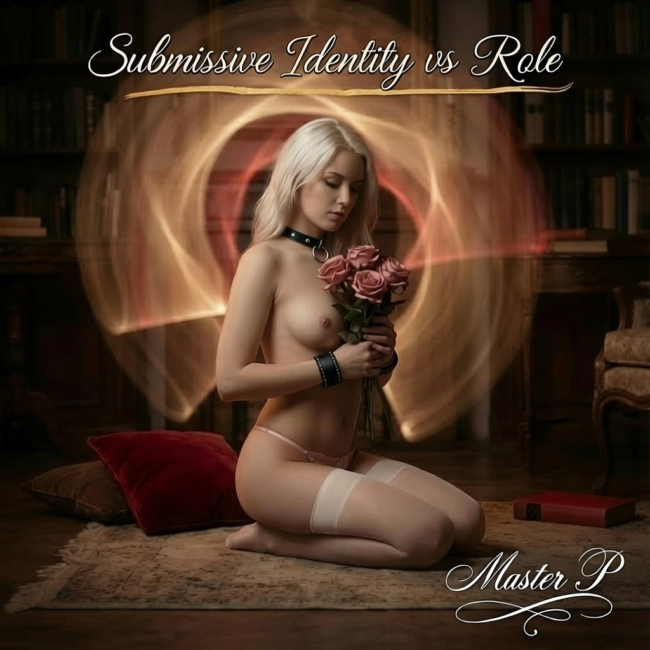
A kneeling woman wearing a collar holds roses in a quiet library setting, symbolising submissive identity beyond a submissive role within the BDSM lifestyle and power exchange dynamic.

Submission as State of Mind, Not Role

The difference between performing submission and living it The submissive role and submission as a state of mind are not the same thing. The difference shapes everything that follows inside BDSM and inside a relationship built on domination and surrender. A submissive role can be sincere, intense, and meaningful. It can carry ritual, structure, and erotic charge. It can be entered consciously and expressed beautifully. But a submissive role remains contextual. It lives inside certain spaces, certain moments, certain agreements. Outside of those moments, the person steps back into a more neutral position. A state of mind does not begin and end like that. It is not activated by a scene or sustained only by protocol. It is an internal orientation toward being led, toward yielding, toward aligning with a polarity that feels natural rather than constructed. When submission is a state of mind, it is not something a woman performs. It is something she recognises within herself. Submission, in this sense, is not an expression of weakness, passivity, lack of strength, or anything similar. It is not the absence of character. It is not a shrinking of personality. It is a direction of energy. A woman can be dynamic in her life, capable, strong in how she moves through the world, and still feel most aligned when she stands beside a man who leads clearly. Strength and surrender are not opposites. They are different forms of power. This is where confusion often appears. Submission is reduced to visible gestures. Kneeling. Titles. Formalities. Obedience in structured settings. Those things can express submission, and I value structure. I value rituals. I value the clarity that comes from defined roles and expectations. But I do not want protocols to become empty formalities that suffocate intimacy. If she calls me Sir, Master, sweetheart, or love, the word itself matters less than the meaning behind it. What matters is that it carries respect, understanding of the dynamic, and genuine intimacy. Structure should support the relationship, not replace it. Ritual should deepen connection, not turn it into theatre. When submission is a state of mind, devotion becomes central . Not devotion as blind compliance, but devotion as a conscious offering of self within a relationship that is meant to last. It is the willingness to align with the man she chooses, to build something shared, to let his direction shape parts of her life because she trusts his vision. That kind of surrender has emotional weight. It is not about isolated acts. It is about building a life. At the same time, a submissive state of mind does not mean disengagement from reality. It does not mean sitting back while life unfolds without her. A submissive is not a slave by default. She is not erased. She participates in decisions, in challenges, in responsibilities. She has opinions, intelligence, and presence. She is part of what is being built. If I compare it to something older, there is an echo of the traditional housewife who chose to centre her life around her husband and family. But we no longer live in that world alone. Today, submissive women and submissive men move through modern life with independence and capability. They work. They create. They lead in their own spaces. Their submission does not confine them to a house waiting for provision. It shapes how they relate within the bond they choose, a structure reflected historically in leather culture and evolving through modern kink communities. The difference, then, is simple but profound. When submission is a role, it is something done within limits, often expressed primarily in the bedroom as part of sexuality rather than as a way of life. When submission is a state of mind, it is a way of relating to authority, to structure, and to love. It continues when there is no performance. It appears in small daily interactions. It is present in how she looks at the man she has chosen, in how she responds to his guidance, in how she finds peace inside his direction. That is the submission I recognise as real. Not because it is louder or stricter, but because it is consistent. It does not depend on the room, the outfit, or the script. It lives in the person.

A kneeling submissive woman holding a Dominant’s hands in an intimate setting, symbolising love in BDSM, devotion, structured power exchange, and emotional depth within the BDSM lifestyle.

Love in BDSM — A Foundational Clarification

Love, Eros and Romance in BDSM dynamics Love in BDSM is frequently misunderstood, both outside and inside the community. In the vanilla world, domination and submission are often viewed as incompatible with tenderness. Hierarchy appears to exclude romance, and explicit power seems to leave no room for emotional depth. From that perspective, once authority is openly acknowledged, affection must fade. Yet misunderstanding also exists within the BDSM community itself. Some practitioners quietly treat love and romance as weaknesses, particularly when they resemble more traditional expressions of intimacy. Emotional openness is sometimes seen as softening authority, as if visible care reduces the seriousness of power exchange . This interpretation fails to recognise what love in BDSM actually represents. Power and affection are not opposing forces. They are capable of reinforcing one another when lived with clarity. Every relationship contains polarity . Even when partners aim for symmetry, differences in energy naturally emerge. One person leads more comfortably. The other yields more fluidly. One sets tone. The other responds. When these differences are left unnamed, they often surface indirectly through emotional tension or subtle struggles for position. BDSM does not invent polarity. It makes it conscious. By naming domination and submission, the dynamic stops unfolding unconsciously and begins operating within a defined structure. Structure alone, however, does not explain love in BDSM. Roles provide clarity, but meaning comes from what animates those roles. If domination were only authority and submission only obedience, the exchange would feel mechanical. What gives it depth is devotion , dedication, and genuine concern for the other person’s well-being. Many submissives experience serving not as compliance but as an expression of affection. Offering alignment, attention, and presence becomes a language of love. Their submission is not separate from emotion; it is one of its clearest forms. At the same time, domination grounded in love is not diminished by care. Many Dominants naturally enjoy control and feel aligned with strong leadership. Total power exchange, when lived within agreed limits, can be intense and deeply fulfilling. Yet intensity does not require erosion of the other person’s capacity. A submissive who remains mentally strong, capable, and aware deepens the exchange. Surrender carries more meaning when it is chosen from strength rather than fragility. Love ensures that control becomes cultivation rather than reduction. Authority shapes and refines rather than weakens. The apparent paradox between unconditional love and defined limits is often misunderstood. Love in BDSM may feel unconditional in orientation, yet every dynamic operates within boundaries. Unconditional does not mean without edges. It refers to steadiness of intention. A submissive may have practical limits, but the direction of her devotion remains consistent. She gives herself fully within the structure that protects her. Her boundaries do not diminish the sincerity of her offering. They safeguard it. The same steadiness applies to the Dominant’s position. When surrender is taken seriously, responsibility becomes constant rather than situational. Guidance is not exercised for ego but for growth. Correction is not about domination for its own sake but about alignment and development. Love introduces patience, awareness, and long-term orientation into power exchange. Without that foundation, structure risks becoming hollow ritual. With it, authority gains depth and purpose. Love in BDSM also clarifies pleasure. The Dominant finds satisfaction in guiding, shaping, and protecting. The submissive finds satisfaction in serving, aligning, and offering herself. Each seeks to please the other according to their role. This reciprocal orientation toward each other’s fulfilment cannot reach its full expression without genuine care. Love anchors intensity so that it does not collapse into performance or instability. There is also a more instinctive dimension beneath this structure. Sexual inclination and relational orientation often precede conscious explanation. Some individuals feel naturally drawn toward surrender long before they can articulate why. Others feel responsibility rise instinctively when faced with submission. Love allows these instincts to mature into conscious practice. It prevents domination from becoming cruelty and submission from becoming self-erasure. Instead, both become deliberate embodiments of polarity. Without structure, love can blur into insecurity or hidden competition. Without love, structure can harden into rigidity. When both coexist, the dynamic becomes stable and alive. Romance does not disappear inside hierarchy. It becomes grounded in it. Love in BDSM is therefore not an accessory to power exchange but a foundational element that allows domination to guide with integrity and submission to flourish with strength. To treat love as weakness within BDSM is to misunderstand the depth that gives the dynamic meaning. Power without love remains shallow. Love expressed through structured polarity becomes enduring.

Marquis de Sade, French writer whose work shaped the meaning of sadism and influenced cultural misunderstandings of BDSM

Marquis de Sade and the Myth Around BDSM

You were told to believe he was the father of BDSM. He wasn’t! BDSM existed long before Marquis de Sade ever wrote a word. Power, surrender, cruelty, ritual, devotion — these currents move through human history far deeper than the 18th century. So perhaps the assumption shifts: maybe he shaped BDSM into what we recognise today.Still no. The truth is more precise, and more revealing. Sade has nothing to do with BDSM as a lifestyle or practice.And yet, he remains deeply relevant to how BDSM is misunderstood. His relevance lies in contrast — and in language. Born in 1740 into French aristocracy, Sade lived in a world obsessed with order: moral order, religious order, social order. Church and State dictated how desire should appear, where it should exist, and who was permitted to express it. Appearances mattered more than truth. Silence protected reputations. Hypocrisy was structural. Sade refused that silence. His writings are not erotic invitations. They are confrontations. Relentless, repetitive, excessive by design. Pleasure is drained of beauty. Cruelty is stripped of symbolism. Power is shown without ornament or justification. He does not seduce the reader; he overwhelms them. Comfort would dilute the exposure. What Sade places on the page is power without recognition. The libertines in his work are not Dominants in any BDSM sense. They do not engage another person as a presence. There is no shared structure, no exchange, no acknowledgement of the other as human. Desire is treated as entitlement. Pain is inflicted because it can be. Power exists without interruption. Through this connection — and because sadism came to mean taking enjoyment in the infliction of pain — the line was blurred. Stripped of context, structure, or meaning, pain becomes nothing more than torture, and Sade’s work brought into full view the vulgar, barbaric actions already present in his era. As a result, BDSM became historically and linguistically entangled with both his name and those actions. But this is not BDSM — at least not as people like me understand it. What Sade exposed was harm without relation, excess without purpose, power without presence. BDSM, by contrast, exists precisely because meaning, intention, and shared understanding are present. This distinction is explored more deeply when examining power exchange as mastery rather than entitlement. The confusion does not come from BDSM itself, but from the shadow Sade cast when pain was severed from everything that gives it shape. Historically, Sade spent decades imprisoned, often without trial. Officially for obscenity and scandal. In reality, for refusing discretion. Many men of his class lived freely while committing similar acts because they respected appearances. Sade wrote openly. He exposed behaviours society preferred to keep hidden, especially when practised by those in authority — a dynamic echoed in later discussions of how unchecked authority distorts human connection . He did not invent cruelty.He removed its disguise. Philosophically, Sade rejected divine morality altogether. Human beings, in his view, were creatures of impulse and appetite, shaped by nature rather than soul. This worldview offers a stark counterpoint to modern BDSM thought, where structure and training exist to prevent power from collapsing into harm . And this is where his relevance sharpens. Sade is not a foundation in the sense of origin.He is a guide in the sense of contrast. The BDSM mindset stands clearer because of him — not by following his path, but by seeing it fully illuminated. Light only carries meaning when darkness is visible, and Sade exposed the night without flinching. By laying bare power stripped of recognition and relation, he made it impossible to confuse cruelty with depth or entitlement with desire. Through him, boundaries gain definition. What is chosen becomes clearer because what is imposed is shown without disguise. What is shared carries weight because what is taken is revealed as empty. Marquis de Sade did not build BDSM.But his name became attached to the very misunderstanding BDSM has spent decades correcting. He revealed the terrain BDSM consciously refuses to inhabit — and in doing so, helped clarify the difference between pain inflicted and pain exchanged, between power taken and power entered. Exploring Sade Beyond BDSM For readers who wish to approach Sade outside any BDSM framing, the following works offer insight into his historical and philosophical position: Philosophy in the Boudoir — dialogues attacking religious morality and social hypocrisy Crimes of Love — short stories exposing emotional manipulation and moral façades Dialogue Between a Priest and a Dying Man — a concise confrontation with religious belief Aline and Valcour — a utopian and dystopian exploration of law, governance, and human nature For additional historical context on how Sade’s name became embedded in psychological terminology, see historical definitions of sadism and cultural misunderstandings of BDSMand consent. Read him carefully.Not for imitation.Not for validation.But to understand where lines are drawn — and why they matter.

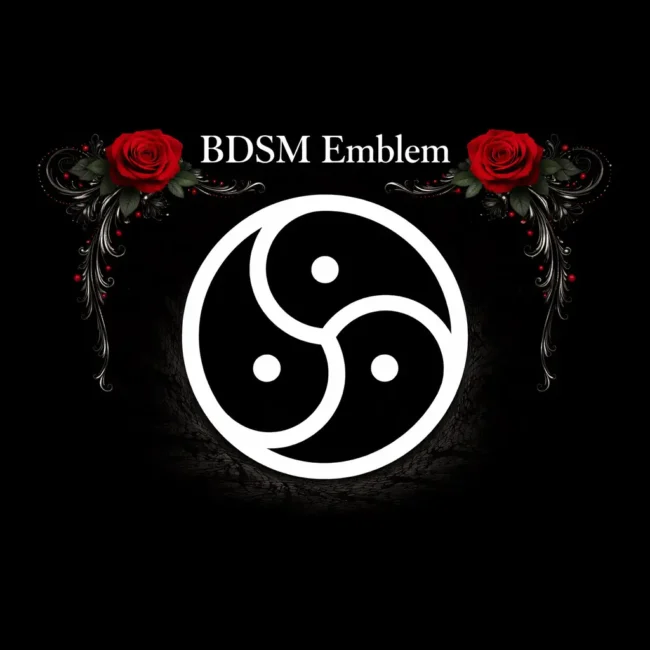
A BDSM emblem featuring a triskelion symbol framed by red roses, representing balance, power exchange, and responsibility within the BDSM lifestyle.

Understanding the BDSM Emblem – Meaning, Design, and Purpose

The BDSM Emblem is a widely recognised symbol within the BDSM community, yet it is often misunderstood or misidentified. This introduction aims to explain what the Emblem is, where its design comes from, and why its details matter, especially for those encountering it for the first time. The Triskele as the Foundation At the heart of the BDSM Emblem is a shape known as the Triskele (or Triskelion). The Triskele is an ancient symbol composed of three curved arms radiating from a central point. It has appeared in many cultures throughout history and has been associated with a wide range of meanings, from motion and balance to cycles and transformation. Because of its long and varied history, it is important to understand that the Triskele itself is not a BDSM symbol. Many Triskeles exist in art, jewellery, and cultural iconography that have no connection to BDSM at all. The BDSM Emblem is a very specific interpretation of the Triskele, distinguished by intentional design elements and symbolic choices. What Makes the BDSM Emblem Unique The BDSM Emblem was deliberately designed with precise features that set it apart from other Triskele-based designs. These include: A black inner background Metallic silver or gold-coloured rims and spokes Three circular holes, often mistakenly described online as dots, which match the metallic colour of the lines An enclosing outer circle that unifies the design These elements are not decorative accidents. They were chosen carefully to create a symbol that could communicate meaning to those familiar with it, while remaining visually subtle to others. A Symbol Designed for Discretion One of the core purposes of the BDSM Emblem is discreet recognition. When it was introduced, the intention was to provide a way for individuals within the BDSM community to identify one another without drawing unwanted attention or publicly disclosing personal interests. To support this goal, the Emblem was designed to appear neutral and aesthetically pleasing rather than provocative or explicit. To someone outside the lifestyle, it typically looks like an abstract or spiritual design, sometimes even resembling the yin-yang symbol. This intentional ambiguity allows it to blend naturally into everyday settings, such as jewellery, clothing, or artwork. Over time, however, the Emblem spread widely across the internet and social media, often without its original explanation. As a result, some people began to assume that any Triskele symbol represented BDSM. This is a common misconception. The BDSM Emblem is defined by its specific design and symbolic intent, not by the Triskele shape alone. Symbolism Within the Design For those who understand its meaning, the BDSM Emblem carries multiple layers of symbolism, each connected to fundamental aspects of BDSM philosophy and structure. The Three Divisions of BDSM Practice The most direct symbolism lies in the three curved sections of the Emblem, which represent the three commonly recognised components of BDSM: Bondage and Discipline (B&D) Domination and submission (D&S) Sadism and Masochism (S&M) These elements describe different but interconnected ways power, control, sensation, and trust can be expressed within consensual BDSM dynamics. The Ethical Foundation: Safe, Sane, and Consensual The three divisions also reflect the ethical framework that underpins responsible BDSM practice: Safe, Sane, and Consensual. This principle emphasises informed consent, mutual understanding, and care for the physical and emotional wellbeing of all participants. It serves as a guiding standard within the community and reinforces that BDSM is built on communication and responsibility, not harm. Community Roles Another layer of symbolism refers to the roles commonly recognised within BDSM interactions: Tops, who take an active or directive role Bottoms, who receive or submit within agreed dynamics Switches, who may engage in both roles depending on context These roles are not rigid identities but general frameworks that help describe how individuals interact within consensual power exchanges. The Meaning of the Holes The three holes within the Emblem are a distinctive and meaningful feature. They symbolise the idea that, within BDSM, individuals are not entirely complete in isolation. BDSM is inherently relational—it relies on interaction, consent, and mutual participation. The holes represent openness, receptivity, and the understanding that connection with a complementary partner is essential. Whether BDSM is approached as a form of play, exploration, or deep emotional bonding, it cannot exist alone. The design visually reinforces the idea that relationships and dynamics are central to the lifestyle. Curves, Metal, and Colour The curved lines of the Emblem echo the flowing boundaries between the different aspects of BDSM. Just as the curved line in the yin-yang symbol suggests that opposites are interconnected rather than sharply divided, the curves here reflect the fluidity between B&D, D&S, and S&M. The metallic colour of the rims and spokes evokes traditional imagery associated with BDSM, such as chains, collars, or restraints. Rather than symbolising oppression, these elements represent commitment, structure, and negotiated power exchange. The black inner sections are often interpreted as a nod to the private nature of BDSM. Black is frequently associated with secrecy or the unknown, and in this context it reflects discretion rather than negativity. It acknowledges that BDSM is often kept separate from public life and shared only with those who are trusted. The Enclosing Circle The outer circle of the Emblem brings all elements together. It symbolises unity, wholeness, and continuity. Within the BDSM context, it can be understood as representing the community itself—a network of individuals connected by shared values of consent, trust, respect, and understanding. A Quiet Symbol of Recognition Ultimately, the BDSM Emblem is not meant to explain itself openly. Its purpose is not to educate the uninformed at a glance, but to offer recognition to those who already understand its meaning. To outsiders, it remains simply an attractive design. To those within the lifestyle, it serves as a subtle sign of belonging and shared knowledge. Unfortunately, the level of secrecy and discretion for which the Emblem was originally designed is no longer as strong as it once was. As the lifestyle has become more visible and less underground, the symbol has increasingly been adopted by…

A kneeling woman in lingerie with a calm, introspective posture, guided by a standing man, symbolising the BDSM lifestyle, power exchange, and the inner world of desire shaped through erotic triggers.

Inner World of Kink Shaped by Desire, Triggers, and Human Sexuality

The world of kink is often misunderstood because it is rarely looked at through the lens of desire itself. Instead, it is judged through morality, habit, or fear. When that happens, kink is reduced to extremes or dismissed as something abnormal. In lived reality, it is far simpler and far more human. Kink begins where desire refuses to fall asleep. Some people can repeat the same intimate patterns for decades without feeling dulled by them. Others cannot. Their desire fades when intimacy becomes predictable. It is not that they love less, or seek novelty for its own sake. Their mind requires stronger, more specific triggers to remain alive to arousal, tension, and connection. This difference is not about intelligence, morality, or emotional maturity. It is about how stimulation is processed. Human sexuality does not function like an on-off switch. It responds to cues. Images. Symbols. Power dynamics. Restriction. Freedom. Anticipation. For some, a familiar touch is enough. For others, familiarity softens desire until it becomes background noise. When that happens, the body does not stop wanting. It starts searching. This is where the inner world of kink takes shape. Not as a rejection of a partner, but as a way of rediscovering them. Many people respond to fading desire by seeking new bodies, new faces, new beginnings that temporarily restore excitement. Others turn inward instead. They look for new triggers within the same bond. Kink becomes a way of renewing intimacy without replacing the person they love. This echoes reflections on how sexuality renews itself through meaning rather than novelty. At its core, kink is about triggers that awaken desire. A trigger is not a pathology. It is simply something that speaks clearly to the nervous system. A position. A restraint. A command. A struggle. A pause. The brain recognises the signal and responds. Arousal follows. Emotion follows. Meaning forms. This process is neither mysterious nor dangerous. It is how human desire works when it is allowed to be honest. Unlike the rest of the animal kingdom, humans are not driven solely by instinct. We are shaped by imagination, symbolism, and memory. Animals do not develop kink because their sexuality does not rely on layered meaning. Human sexuality does. The same act can feel empty or electric depending on context, intention, and perception. This is why kink exists only where the mind is involved. The world of kink is often wrongly collapsed into sadomasochism alone. Pain becomes the focus, while everything else disappears from view. In reality, kink may involve no pain at all. It may be bondage without discipline. Discipline without pain. Domination and submission without impact. Or nothing more than the quiet tension created when one body is restrained and admired. The struggle of a bound body can awaken emotion not because of suffering, but because of vulnerability, exposure, and trust. These layers connect with how restraint and surrender communicate meaning without force. For many, the erotic charge comes not from harm, but from contrast. Strength and surrender. Control and release. Stillness and strain. The body communicates something the mind cannot articulate. Desire deepens not through repetition, but through intensity of experience. When intimacy reaches this level, it stops being mechanical and becomes expressive. This does not mean that vanilla intimacy is lesser. It means that it functions differently. Many people carry small kinks without naming them. Blindfolds. Light restraint. Power play in tone or posture. These are not deviations. They are signs that desire responds to more than touch alone. For those who live fully in the world of kink, these triggers are simply more pronounced and more necessary. Kink, then, is not about excess. It is about precision. About knowing what awakens desire and allowing it to exist without shame. It is an expression of sexuality that values honesty over conformity and depth over routine. When understood this way, kink does not stand outside human sexuality. It reveals something fundamental about it. Reflections on how erotic expression shapes culture and identity appear across broader kink-aware writing. The inner world of kink is where desire remains awake. Where lust is not dulled by habit. Where intimacy is renewed through meaning rather than replaced through novelty. It is not an escape from reality, but a deeper engagement with it. And for those who live there, it is not madness. It is recognition.

A woman standing between scales and a flower, symbolising balance, dignity, and responsibility on Women’s Day, reflecting respect that goes beyond symbolic celebration

Women’s Day: Why Women Deserve More Than a Single Day of Respect

Respect Beyond Celebration Women deserve more than a day. I have believed this long before I ever paid attention to Women’s Day itself. When Women’s Day comes around each year, I don’t feel celebration. I feel unease. Not because honouring women is wrong, but because needing a specific date to remember respect says something uncomfortable about how easily it disappears the rest of the time. In my life, respect is not seasonal. It is not symbolic. It is not something I perform publicly and forget privately. The women who have entered my world, lovers, submissives, partners, companions, have shaped how I see strength, vulnerability, and responsibility. That experience has made it impossible for me to accept gestures that replace behaviour. I have watched how easily respect is spoken and how rarely it is lived. I have seen care used as a mask for control. I have seen protection used as an excuse to limit expression. I have seen silence praised as maturity while women swallowed discomfort to keep the peace. None of this announces itself as cruelty. That is what makes it dangerous. It arrives quietly, wrapped in tradition, expectation, or concern. When these patterns are questioned, they are often defended as normal, as if normality itself were a moral shield. This is why a single day of celebration rings hollow to me. It allows people to feel aligned with respect without changing how they behave when no one is applauding. It creates a moment of comfort instead of a demand for consistency. What women need is not recognition. It is reliability. Real respect reveals itself in small, uncelebrated moments. In how disagreement is handled without intimidation. In how boundaries are met without punishment. In whether a woman is listened to when her voice complicates convenience. These things cannot be condensed into a date. I do not believe women should have to prove their worth through endurance. I do not believe dignity is something earned by compliance or sacrifice. Value is not conditional. It is inherent. Difference does not diminish worth. It never has. This belief did not come from theory. It came from proximity. Living a BDSM lifestyle stripped away many of the illusions I once saw tolerated elsewhere. In BDSM, there is nowhere to hide for long. Pretence collapses quickly. Power exposes intention. Desire demands honesty. If responsibility is missing, harm follows fast. I explored this foundation of balance and responsibility in my reflections on the symbolism behind power itself . That environment taught me something I now carry everywhere. Respect cannot be implied. It must be carried deliberately. This same understanding of restraint and responsibility runs through my writing on holding submission with care rather than entitlement. In my BDSM world, a woman’s submission is never assumed. It is offered. It is held. It is protected. Authority is not taken because one can take it. It is accepted because one has proven capable of carrying it. Anything less is not Domination. It is negligence. This clarity has made it impossible for me to accept surface level respect elsewhere. Once you have lived in a space where power and care are inseparable, symbolic gestures feel thin. You start noticing how often respect is spoken about, and how rarely it is practised when restraint would cost something. Women deserve environments where their choices are honoured without justification. Where their boundaries are not negotiated down. Where their presence is not tolerated but welcomed. None of this requires celebration. It requires discipline. This is the uncomfortable truth I have come to accept. What many people hope to achieve through annual recognition, some ways of life demand every single day. Respect is not a slogan. It is not a performance. It is not optional. In my world, and in my BDSM world, women deserve more than a day. They deserve steadiness. They deserve restraint. They deserve respect that does not disappear when the calendar moves on. Every day.